PRINTABLE WORKSHEET
Moon phase journal
Record seven days of Moon observations with dates, sketches and notes. Free printable PDF in A4 and US Letter.
Print your worksheet
One page. Choose the size that matches your paper and print at 100%.
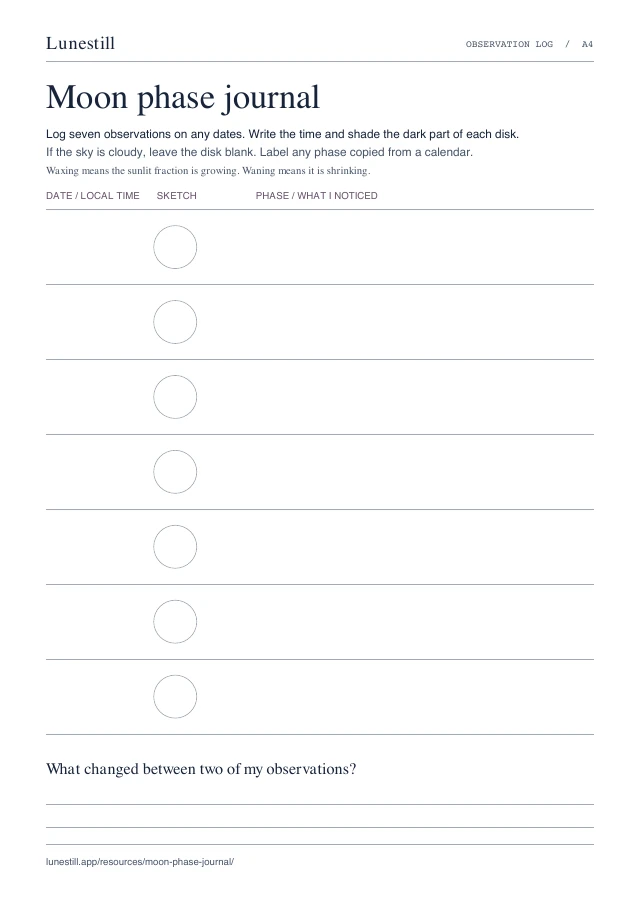
How to keep a Moon journal
- Pick a starting date. For each observation, write down your date and local time. Daylight observations count, too.
- Shade the dark part of the blank circle, leaving the sunlit part white. If clouds cover the Moon or it is below your horizon, leave the circle empty and write what you could see.
- Add the phase name if you know it. Compare two entries at the end of the week and answer the question on the sheet: What changed between two of my observations?
What does the illumination percentage mean?
Illumination describes how much of the Moon’s disk appears sunlit from Earth. At first and last quarter, roughly half the disk looks bright. Waxing means that bright fraction is growing. Waning means it is shrinking. To tell which way it is changing, compare observations across days.
In Lunestill, open Week and select a date to see its calculated phase and illumination. If you use the app on a cloudy day, label your entry “from the calendar” so you can distinguish it from a sighting.
A sample entry
Tuesday, 4:15 pm. A pale half-circle above the rooftops. The lower edge disappeared behind a cloud twice.
“About half lit” is enough for this entry. One drawing alone may leave the phase uncertain. Seven observations give you part of a lunar cycle, so you can start on any date.